Discrimination Victims Deserve REAL Justice

The EEOC has asked for public input so here goes:

Why is the EEOC operating the equivalent of a “get out of jail free card” for employers that engage in employment discrimination and retaliation?

When the EEOC determines there is reasonable cause for a charge of discrimination, the agency offers the employer (and the victim) the opportunity to participate in its free mediation program, where a neutral mediator assists the parties in reaching an early and confidential  resolution to a charge of discrimination.

In its 2014 performance report, the EEOC contends the mediation program is a “win for both Employees and Employers” but in the final analysis it is a much bigger win for employers.

The EEOC says its mediation program for private sector complainants  achieved a resolution in 7,846 out of a total of 10,221 mediations conducted for all types of discrimination.  The effort yielded $144.6 million in monetary benefits for complainants. Simple division indicates the EEOC’s mediation effort yielded $18,430 per mediation for private sector workers in 2014.

A payout of less than $20,000 per mediation is a bona fide windfall for employers, who might otherwise be forced to spend a hundred thousands dollars or more to defend a lawsuit, plus a potentially staggering damages award.

But $20,000 is a pittance at best for many – if not most – victims of employment discrimination – especially those who lost their jobs or who were not hired because of illegal discrimination.

There’s the rub

The EEOC is not supposed to be in the business of protecting discriminatory employers from the reasonable consequences of their harmful actions. [Read more…]

Worker Entitled to a Fair Investigation (in the UK)

justice-scale-761665_1In the United States, so-called workplace investigations can be little more than pre-trial preparation for employers intent upon building a record to justify dismissing a troublesome worker.

It is refreshing to note a recent  decision by the London-based Employment Appeal Tribunal (EAT)  finding  a breach of an implied term of trust and confidence where an agency’s Human Resources Dept. interfered in the outcome of an investigation of employee misconduct.

In Ramphal v. Department for Transport,  a manager  was investigating alleged misconduct by an aviation compliance inspector, who allegedly filed a false expense report.  The manager’s initial report concluded that any abuse was not deliberate. After the manager sought advice from HR, he switched his recommendation that the employee receive a written warning for misconduct to a recommendation that the employee  be summarily dismissed for gross misconduct.

The EAT said the lower court erred when it failed to determine whether HR had exerted “improper influence” over the manager’s decision to dismiss the worker

The EAT said a worker facing disciplinary charges and a dismissal procedure “is entitled to expect that the decision will be taken by the appropriate officer, without having been lobbied by other parties as to the findings he should make as to culpability.”

According to the  EAT:

“… an investigating officer is entitled to call for advice from human resources; but human resources must be very careful to limit advice essentially to questions of law and procedure and process and to avoid straying into areas of culpability, let alone advising on what was the appropriate sanction….. It was not for Human Resources to advise whether the finding should be one of simple misconduct or gross misconduct”.

In the United States, most workers who do  not belong to unions or receive the protection of an employment contract can be fired for almost any reason – without any cause –  as long as the reason doesn’t break an actual law (i.e. discrimination)  or a narrowly defined public policy (i.e. protection for whistleblowers).  There is no legal requirement that employers treat workers with respect, dignity and fundamental fairness.  Of course, employers who are not fair  risk significant liability if the worker later files a lawsuit alleging a violation of the law, such as a race or sex discrimination lawsuit.

The Employment Appeal Tribunal is a superior court of record in the United Kingdom that hears  appeals from Employment Tribunals in England, Scotland and Wales.

Progress? Obama Acknowledges the “Elderly”

ObamaOnce again, President Barack H. Obama, in his 2016 State of the Union address, describes an America that is populated by “hard-working families,” immigrants and select  minorities.

But at least this year older Americans were not entirely invisible. He made two fleeting references to older Americans, which is two more than he made in his 2015 address.

Pres. Obama, 54, said Social Security and Medicare are “more important than ever. We shouldn’t weaken them. We should strengthen them.” (Unfortunately, he didn’t say what, if anything, he would do to accomplish this goals.)

And Pres. Obama applauded the “elderly” woman who waits in line to cast a vote as long as she has to.

FYI, Pres. Obama – the term ‘elderly’  is  frowned upon today as a descriptor for older Americans because it evokes images of frailty, sickness and decline. The term reflects underlying attitudes about aging that are stereotypical and negative. “Elderly” certainly doesn’t describe the millions of older Americans (like you!) who are vital, energetic and very much engaged in life. The International Longevity Center advises journalists to use the term “older adult”  to describe Americans over the age of 50. Good advice.

Obama completely ignored older Americans last year, which was not entirely surprising given that he has ignored older Americans for the past seven  years.

The Obama administration has not represented a period of enlightenment regarding older Americans.  Obama is the first American president, at least in modern times, to actually endorse age discrimination in hiring.  Obama promised in 2009 to work to strengthen the Age Discrimination in Employment Act of 1964. Not only didn’t he do that but he signed an executive order in 2010 that permits federal agencies to bypass older workers and hire recent graduates.  Moreover, Labor Secretary Thomas E. Perez supported a private initiative last year by America’s largest corporations to provide jobs to 100,000 inner city “youth” aged 16 to 24, despite the fact that using age as a factor in hiring violates the plain language of the ADEA.  Until Obama was elected,  federal policy supported  job training programs and internships to bolster employment for youth and minorities.

It was Obama’s last State of the Union address. He can take credit for many accomplishments in office but he didn’t do a dang thing for older Americans, many of whom lost jobs, investments and homes in the 2008 recession and have struggled for years with chronic unemployment due to epidemic age discrimination in hiring. The Economic Policy Institute reported in 2013 that about half of Americans aged 65 and older are either in poverty or at risk of poverty.The highest rates of poverty among older Americans are suffered by women  and minorities.

NPR’s Diversity Problem: Why So Few Women Sources?

The high-tech industry in Silicon Valley isn’t the only American industry with serious diversity problems.

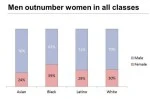
National Public Radio this week reported that male sources outnumber female sources on the network’s two largest weekday newsmagazines by two-to-one.  Sources include on-air personalities and  subject matter experts, Only about 30 percent of all  sources on Morning Edition and All Things Considered were female in the fiscal year ending Sept. 30, 2015. There has been no improvement for the past three years.

Women, who comprise 50.45 percent of the U.S. population, are under-represented along all racial classes.

NPRDiversity

Here are the percentage  of male/female sources broken down by race:

  • Asian : Males, 76%; Females 24%.
  • Whites: Males, 70%; Females 30%.
  • Latino: Males, 71%; Females 29%.
  • Blacks: Males 62%; Females 39%.

Women and Latinos are severely under-represented as NPR sources.

The percentage of NPR sources who are Latino remained flat at six percent for each of the three years. The U.S. Census Bureau reports that Latinos make up 17.4 percent of the U.S. population.

Here is the breakdown of sources by race from the NPR report:

  • There was a decline in the overall percentage of white sources, from 80 percent in 2013 to 73 percent in 2015.   Whites make up 77.4 percent of the U.S. population in 2014.
  • African-American voices rose from 5 percent in 2013 to 11 percent in 2015. African-Americans comprise 13.2 percent of the U.S. population.
  • The share of Asian sources rose to eight percent in 2015, compared to five percent in 2013.  Asians comprise 5.4 percent of the U.S. population.

Asians as a group are actually over-represented but Asian women lag the farthest behind in any racial group.

Of course, the U.S. population is not the same as NPR’s listener-ship. NPR listeners are 85 percent white, eight percent Latino and seven percent black.

Keith Woods, NPR’s vice president for diversity in news and operations, is quoted as stating he is “generally pleased with the direction that this is going,” noting the increases in the share of black on-air sources, as well as the percentage of “subject matter experts” who are people of color. He said he had “hoped for better news on our coverage of women, on our inclusion of women.”

Note: Two protected classes were not surveyed by NPR, age and disability.